
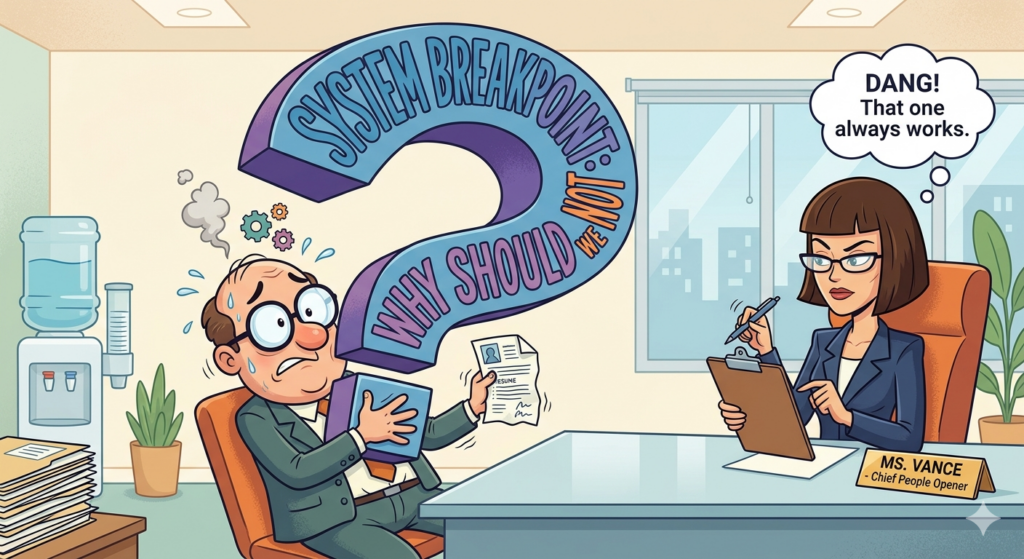
Why should we not hire you?
If there’s one question that can throw us on our back foot as interviewees, it’s that one, because it causes cognitive disruption. That tiny word, not, throws off our normal thinking pattern.
You may even wonder whether you heard correctly. (Did they really say, not?)
But this is a brilliant question and one you can nail, if you’re prepared.
First, to bypass this disruption, reframe the question as:
What is a risk I represent, and how do I mitigate it?
This converts the question into a problem-solving exercise, which the brain handles much more efficiently.
And the risk doesn’t have to be negative. It might simply be that you do things differently compared to your peers.
To answer it, home in on what sets you apart. If we’ve worked together on your resume, we’ve already figured out how to showcase your greatest strengths. It’s now just a matter of articulating your special sauce in a new context.
Here’s an example of how I might respond to that question:
I like to get to the point quickly.
When I rewrite resumes, I’m constantly pruning words and details that don’t add value. And I only use graphics that clarify the content.
So, if you’re looking for someone who provides a lot of detail, I may not be a good fit.
But if you’re looking for someone who’ll deliver a clear, concise, and modern resume tailored to the company’s needs, I’m the writer you want.
Create a story vault
Besides that curveball, there are myriad other questions the interviewer might ask you. But don’t get overwhelmed trying to figure out which one.
If you create a list of core categories of questions and your responses, you’ll be able to pull from those, then tweak to fit the various ways they might be asked.
The most common questions are behavioral. There’s a reason recruiters rely on these types of questions: when candidates share specific examples of past behavior, it helps predict future job performance.
These questions typically start with “Tell me about a time when…” and focus on soft skills like conflict resolution, leadership, adaptability, and problem-solving.
Use the following prompts to create a library of responses:
- Conflict & Teamwork: “Tell me about a time you had to work with a difficult team member.”
- Problem-Solving: “Give me an example of a time you used good judgment to solve a problem.”
- Failure & Growth: “Tell me about a time you failed and how you handled it.”
- Adaptability: “Describe a time you had to manage multiple, competing deadlines.”
- Leadership/Initiative: “Describe a situation where you went above and beyond.”
- Pressure: “Tell me about the most stressful situation you’ve faced at work.”
Practice, practice, practice!
The next step is to find a practice partner for answering these questions.
Comedians test their jokes in clubs before sharing them with the world on Netflix. Even Will Arnett, in preparation for the movie Is This Thing On?, about an amateur comedian, tested his material in small clubs first. (Great movie, BTW.)
What if you took a cue from a comedian and tested your responses with different audiences, to see how they land?
💡 Pro tip: Ask your practice partner to pose the questions in different ways, so you learn to adapt your responses.
If you focus your energy on preparation now, you can be fully present when it counts.
I’m here to practice with you, as well.
Copyright © 2026 Words of Distinction, All rights reserved.