Oh, how many times have I heard that, only to dig deeper to find that these unassuming clients were actually movers and shakers.
A sampling:
The senior tech manager who convinced C-suite leaders to invest in new software—and helped propel the company toward its goals.
The account manager who unified teams across marketing, operations, and finance to support a key sales initiative that sparked 10X millions of dollars in revenue—and established trust for future high-ROI projects.
The volunteer fundraiser who built and nurtured hundreds of donor relationships—while creating innovative revenue-generating community events—to guarantee a long-term competitive high school music program.
The engineering/client liaison who skillfully uncovered the true needs of the customer, articulated those needs to the engineering team, and then distilled the technical requirements back to the client.
These employees sound like leaders to me.
Even if you’ve never formally led a team, you may have more to say about your ability to lead than you realize.
I recently had a client who epitomized what it meant to lead from behind.
I hope you had a wonderful Thanksgiving and that you’re off to a joyful, low-stress start to the holiday season.
Speaking of low stress, I recently had a refreshing conversation with Lynda McDonell from PiqueProsperity. A financial coach, Lynda has an unconventional approach to managing finances—specifically during a career transition.
Spoiler alert: You don’t have to give up everything in order to be fiscally responsible when the going is tough.
For more than a year, there was a billboard near my home that read “BETTER LEFT UNREAD THAN DEAD.” It was a powerful ad that aimed to convince drivers that no risk was worth texting while driving.
The problem for my hyper-orderly mind was that grammatically, the subject of “dead” was the text, not a person—an incongruence that wreaked havoc on my grammarian sensibilities. In other words, the writer didn’t follow the rule of parallel structure.
Parallel Structure Defined
As a refresher, the rule of parallel structure calls for the repetition of a chosen grammatical form within a sentence or bulleted list. By following the same grammatical pattern for each listed or compared item, you ensure parallel construction.
So every time I drove by that sign, I’d get annoyed and try to think of a better way to say it that was grammatically acceptable. (Yes, I realize this puts me on some sort of OCD spectrum—hopefully I don’t scare up too many bad memories from high school English😅).
I’ll admit—I’m hard-pressed to come up with a grammatical alternative that’s just as powerful. No doubt (and hopefully!) the ad folks spent some time around a conference table debating alternatives, finally settling on poetic license to justify their form. And let’s face it: The meaning is clear.
Unfortunately, most of us can’t claim poetic license if we make grammatical mistakes in our resumes and other career docs. So we need to make sure our content is strong both in terms of storytelling AND grammar.
Image credit: RapidEye from Getty Images Signature
I remember a time during my corporate days when we’d sit around the conference room and discuss how we’d “leverage” things.
As in “leverage ad spend,” “leverage available retail floor space,” “leverage our high-demand product to get more retail ads.”
There was a LOT of leveraging going on!
During the pandemic, “pivot” emerged as the popular kid. My rebellious nature told me to avoid using this word at all costs. And most of the time, I’ve managed to do that, through replacement words and phrases like “change course,” “shift,” and “adjust.”
But honestly, there’s no word that quite conveys what we’ve all had to learn to do over the past couple of years, so I’ve settled on grudging respect for the term.
Case in point: When one of my clients returned for a resume refresh, I asked her if she’d like me to replace that word. But she liked “pivot” just as much as she did when I originally used it pre-pandemic. So we left it in.
The point is, no word is inherently bad. Not even “leverage.” We just need to be mindful of when and how we use them.
👉 Don’t confuse buzzwords with words that can bolster a bullet.
Buzzwords won’t necessarily add strength to your career profile. In fact, if used as filler or to amplify already-weak content, they’ll just slow down (and potentially annoy!) the reader.
Here’s an example of a phrase (in the resume’s top branding section) that I reworked for a client:
Skilled strategist maximizing workable solutions and performance for key marketing goals.
Unfortunately, there’s nothing here that tells a hiring manager what the candidate actually accomplished. Instead, the reader gets a hodgepodge of buzzwords that are thrown together with no apparent value.
During our intake meeting, I had a chance to uncover the actual meaning behind that sentence, and translated it as follows:
Strategic Product Leader known for introducing scalable solutions that help companies exceed ambitious revenue goals.
In the revised sentence, I combined “marketing” and “strategist” at the beginning to convey who the candidate is right from the get-go. And a record of exceeding revenue goals gives the recruiter a reason to follow up with the candidate.
Sure, “scalable solutions” might be considered a buzz phrase, but it was relevant to what the company was looking for, and it matched their language.
💪 Exercise: Print out a copy of your resume, bio, or cover letter, and ask a friend to highlight any sentences that are confusing.
TIP: Tell them they don’t have to edit (and listen for the sigh of relief). Ask them to just identify anything that doesn’t make sense with a quick read. Nothing works better than a fresh pair of eyes to uncover what’s not working.
Once you get your feedback, play with the words, rearrange them, and see what you can cut. Hands down, the #1 reason resumes are a drag to read is that they’re bloated with words that don’t convey value. Have fun on the chopping block!
Nothing kicks off a good resume like a strong headline, but all too often, we settle for a mediocre one that sounds like the title of a job description.
✨But this is your chance to give a GREAT first impression, so use words that speak to your EXCEPTIONAL value as a candidate.
For example, what if you’re a Director of HR, but you aspire to a more prestigious leadership role—say, VP of People?
You definitely don’t want to misrepresent your experience by giving yourself the title of “VP of People” if you’ve never held that role.” However, if you think about what makes you unique compared to your competition, you can use that quality to elevate yourself in the eyes of the reader.
Here’s what I mean:
Do you have a record of contributing to the bottom line as an HR Director?
What about something like People Leader Committed to Profitable Growth?
If you’re a Digital Entertainment Director who is asked to speak at international industry events, how about:
Digital Entertainment Industry Leader Recognized for Pioneering Ideas
OR
Global Digital Entertainment Industry Leader & Keynote Speaker
See what I did there? It’s all accurate, but you’re no longer narrowly defined.
Of course, the reader will see your current leadership and achievements in your experience section, but if you capture your role and contributions succinctly yet powerfully in the header of both your resume and LinkedIn profile, you’ll have established your role in the reader’s mind before they even begin to scan the rest of your content.
💪 Exercise: Think of ways to bulk up your headline using factual modifiers that can easily be backed up in the branding (summary) and experience section.
I’m known to avoid modifiers. But if used in this strategic way, you’ll notice that your resume and LinkedIn profile will stand out from the beginning.
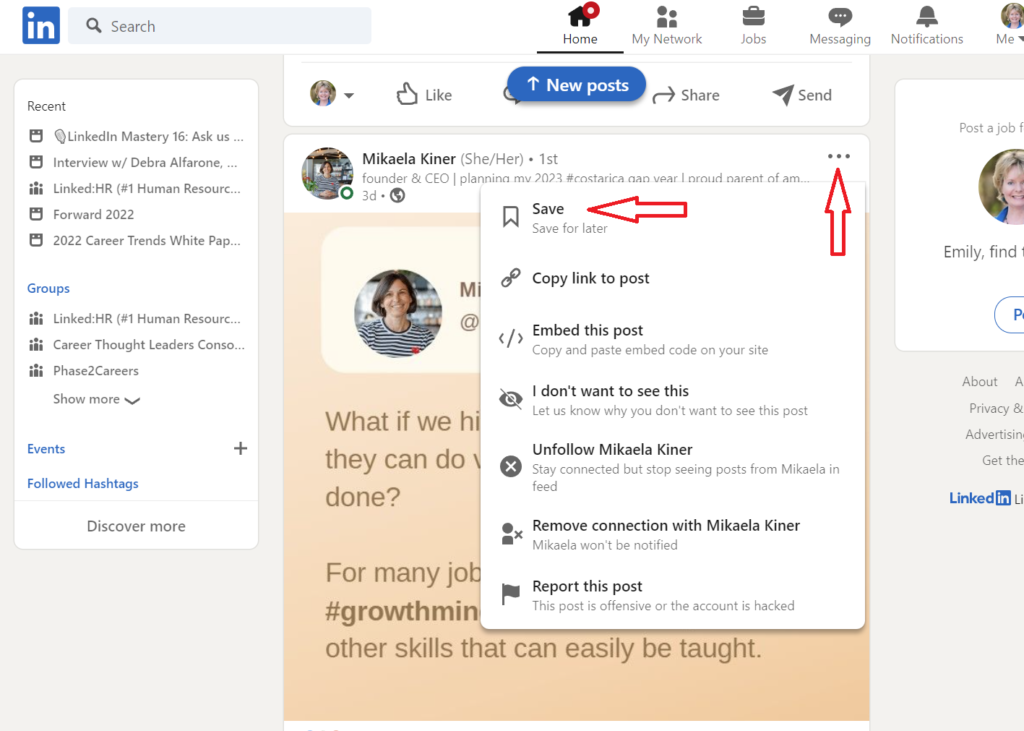
Ever get frustrated because there’s an interesting post on LinkedIn, but you don’t have time to read it…and the next time you go looking for it, you can’t find it?
Did you know you can save a post to read later?
Here are the instructions:
To save the post… Click the 3 dots just above the content you want to save. Click “Save.”
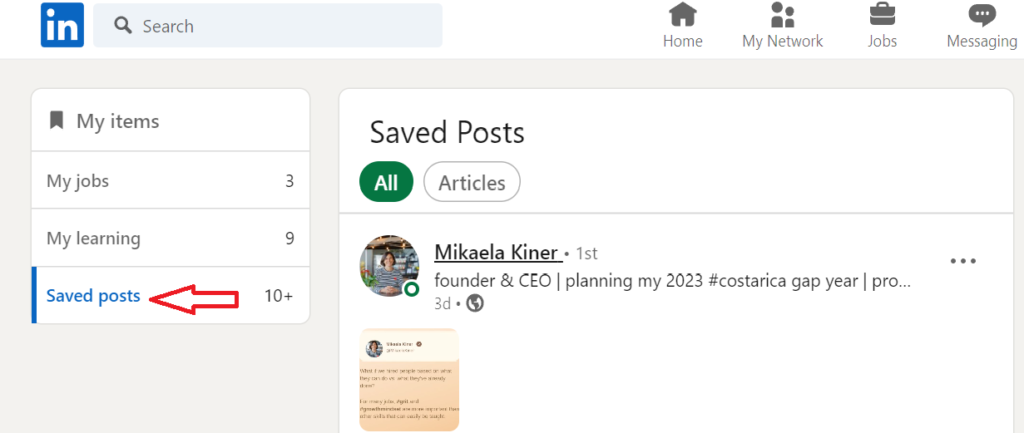
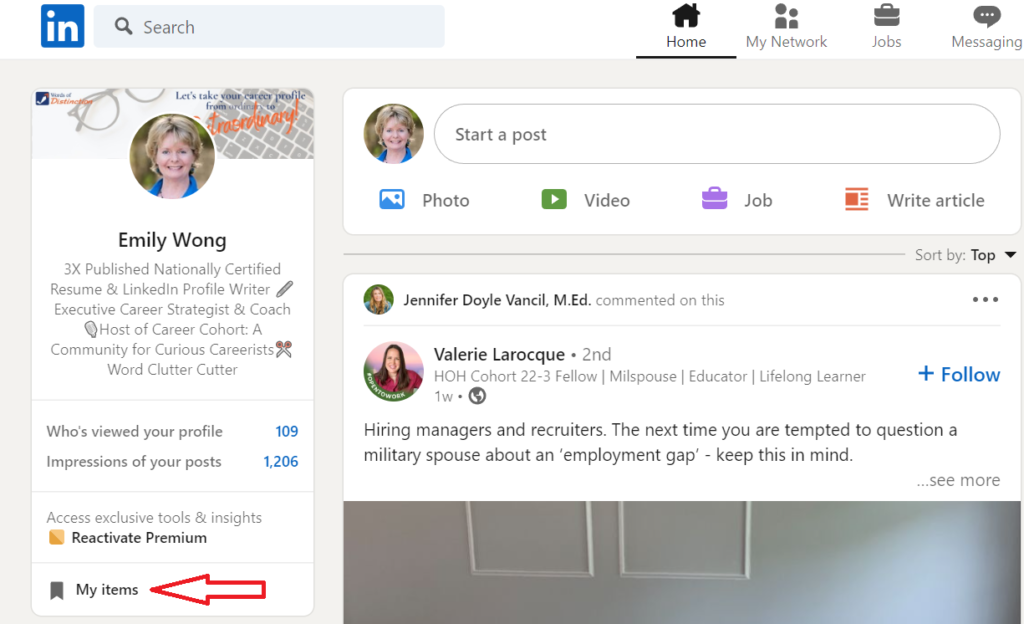
To view your saved content later… Click “My items” on the left of your LinkedIn homepage.
Click “Saved posts” from the list under “My items.”
Sometimes, it’s just a matter of rearranging or cutting those tiny words that don’t add value.
✨To be clear, there’s nothing grammatically incorrect about these words. But consider your audience, who likely has a lot of other resumes to get through.
Anytime you can cut words or shorten sentences is a chance to gain favor from a busy reader.
Here are a few tiny words you can tinker with:
1. …of…
Instead of Improved standards of quality.
Try Improved quality standards.
Instead of Oversaw restructure of 3 organizations.
Try Oversaw 3 restructures.
💪 Challenge: Do a quick word search for “of.” If you eliminate that word and rearrange the text as I’ve done, are you able to say the same thing?
2. …in order to…
A common phrase in business communication is “…in order to…” But your (bullet) point will be stronger if you just say “to.”
Here’s an example:
Instead of Expanded to new platforms in order to increase subscriber base.
Try Expanded to new platforms to increase subscriber base.
💪 Challenge: Scan for resume for “in order to” and replace the phrase with a simple “to.”
3. …related to…
Here’s another phrase you can cut and rearrange the text to keep things trim:
Instead of Conducted due diligence related to M&As.
Try Conducted M&A due diligence.
💪 Challenge: Do a search for “related to,” cut it, and rearrange the text.
Don’t let those pesky little words creep into your resume and weigh it down.
✨ Bonus: cutting unnecessary words might also be the solution to that annoying orphan line (you know, the one that only has one lonesome word) that takes up valuable resume real estate.
Besides trimming and rearranging the little words, look for sentences where you can cut the extra fat (aka jargon).
✨ Don’t confuse buzzwords with words that actually bolster a phrase. Jargon won’t add the strength you need for a powerful profile. In fact, it’ll slow down the reader.
Here’s an example of a phrase I worked on with a client:
Original sentence: Maximized workable solutions and performance for key market goals.
Revised sentence: Fueled 4X revenue growth and tripled active subscriptions by expanding to 3 new platforms.
See the difference we made by replacing buzzwords with specifics and substance?
As writing expert Roy Peter Clark reminds us in his book, How to Write Short, word clutter hides a clear focus.
💪 Exercise: Print out a copy of your resume and other documents and ask a friend or relative to review them for clarity, highlighting sentences that are confusing.
HINT: Tell them they don’t have to edit (and listen for a sigh of relief). Ask them to just identify anything that doesn’t make sense with a quick read. Nothing works better than a fresh pair of eyes.
When you get the document back, play with the words, rearrange them, and see what you can cut.
A leading cause of recruiter frustration is when resumes are bloated with unnecessary and clunky words that confuse and slow the reader.
If your resume is easy to read, I guarantee you’ll be a step ahead of your competition and earn points with those who are doing the hiring!
Who hasn’t heard that from well-meaning coaches and others in our orbit who want us to get focused and get a job—fast.
Seriously?
Think about it. First of all, it’s nebulous, with no start or end date.
Second, it can be daunting to think about adding another 40+ hours to your already-packed week.
Even if you’re unemployed, you’re (hopefully!) either filling those traditional employment hours with upskilling or volunteering in a meaningful way that will help you advance your career and give you a sense of purpose.
I’d never suggest that you approach a product launch or bathroom renovation with a second-job mindset, so why would I ask you to do that with your job search?
Instead, I’d recommend managing your job search like a project, which means setting up a plan just as you would any other major endeavor.
Following are 5 rules to create a framework for your successful job search project:
Photo credit: Patrick Daxenbichler from Getty Images
Let’s talk about ATS. If you’re not familiar with ATS, it stands for applicant tracking system, and it basically serves as the gatekeeper for your resume when you apply online.
If you’re like a lot of job seekers, you have questions about whether or not your resume is ATS-friendly.
If you’re like some, you may even break into a sweat at the mention of the term and the thought of those scary little bots, rubbing their tiny bot hands, and thinking up evil ways to prevent your precious resume from reaching the hands of a hiring manager.
3 questions that rise to the top of my clients’ lists of concerns when it comes to ATS:
How can I present my skills to ensure they get read?
Do columns, tables, and other formatting affect readability?
Is it OK to use text boxes, graphs, and images?
Well, my friend, I hope the following answers will put your mind at ease and help you with your resume-writing strategy.
You don’t feel the need to shout your achievements from the rooftops. You’re a high achiever, and there’s a reason you got where you are: you spend more time showing what you can do, so you haven’t needed to talk about it.
And to be clear, showing vs. telling is the first rule of creating a standout career profile.
But you have to promote yourself to rise above the competition.
So, where’s the balance between obnoxious self praise and underselling yourself?
While all elements in your career profile should complement each other in promoting you as the best candidate, each plays a slightly different role in the process, and therefore works best with a nuanced tone.
Let’s look at the 3 main elements of your career profile—your resume, LinkedIn page, and cover letter—and how using those subtle changes in tone for each will create a compelling package that’s irresistible for the reader.